
Thank you for visiting my website.
Mechelaars van Vessald
Thank you for visiting my website.
Mechelaars van Vessald
I am a professor of medicine and a scientist by profession, and apart from fly fishing, country life, artisanal cheeses made with freshly milked milk, grilled meat, and various contemplative hobbies such as reading and classical music that I cultivate with zeal and great pleasure, I have always been a man of principles, and of dogs.
A large, red, mixed-breed dog named “Campeón” helped me take my first steps, and since then I have owned and trained working dogs of various breeds. Although in the Spanish language breeds are written in lowercase (pastor belga), on this page I will use uppercase (Pastor Belga) in order to highlight them.
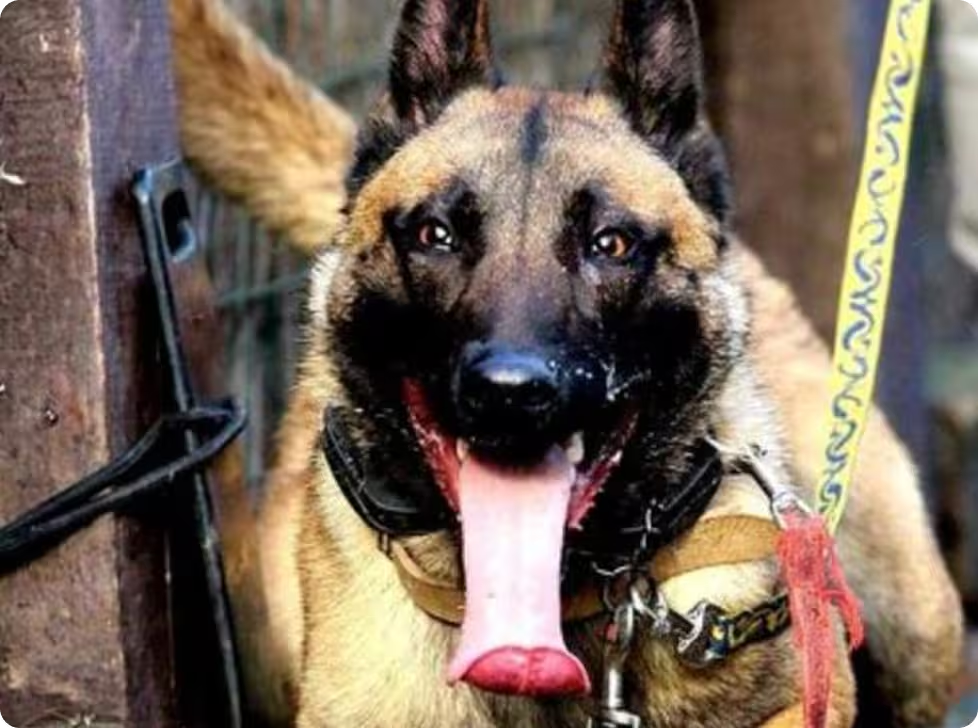
The Mechelaar and the Belgian Shepherd
Since 1970 I have bred, although very occasionally, breeds as popular as the German Shepherd and the Rottweiler, as exotic as the Boerboel from South Africa and the Patterdale Terrier from the United Kingdom, and as gifted as the Mechelaar from Belgium.
Although I have given many away, I have never sold a dog, and I don’t know if I ever will.
If you are reading this page it is because you are interested in the Mechelaar, or put in common terms, you are looking for truthful information about the working lines of the dog of the Belgian Shepherd breed, Malinois variety. There are three other varieties of Belgian Shepherd, namely, Lakenois, Tervueren and Groenendael, whose genetic value for the breed is enormous, but their selection has focused more on appearance than function and that is why I will not refer to them.
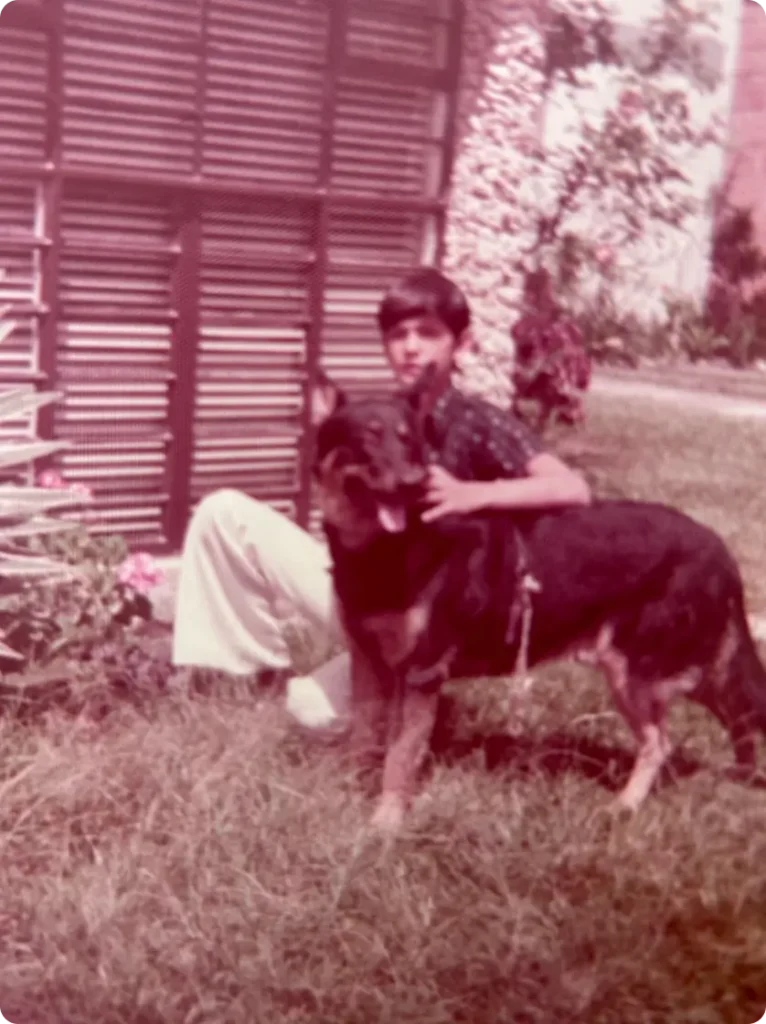
Orión, Medellín, 1973
The Dutch Shepherd (Dutch Shepherd or Hollandse Herdershond) was originally the fifth variety of Belgian Shepherd, but some influential figures did not like its brindle color and, in an act of extreme genetic ignorance, the Committee of the Book of Origins (LOSH) of the Royal Society of San Humberto (SRSH) excluded it forever from the breed in 1973. Today, the Dutch Shepherd represents the essence of the working dog in the Netherlands. To understand the reason why I prefer to call the protection lines of this very special variety by its almost unknown name in the Flemish language (Mechelaar) instead of the very popular in French (Malinois), you must continue reading and learn a little about the history of the dog in general and the working dog in particular.
If the matter is of interest to you and you wish to delve into it, you will find the references at the foot of the page, carefully chosen from my readings of the last 60 years, but obviously biased by my convictions. If you prefer to delve only into what concerns the police dog without suffering my biases, I suggest you study the great book of the engineer and canine historian James R. Engel, which you can read or download from the Internet at no cost thanks to the generosity of its author [1].
The Origins of the
Dog and Man

Long before the development of agriculture 10,000 years ago and the domestication of any animal, man (Homo sapiens) and dog (Canis lupus familiaris, Linneus 1758) evolved together after forging their eternal alliance [2], based on an unparalleled and unidirectional loyalty of the second towards the first [3].
Today we know that the dog and the gray wolf (Canis lupus) share the same ancestor, the now extinct Late Pleistocene Wolf (Canis lupus spelaeus Goldfuß, 1823), and that each species took its own genetic course 14,000 to 40,000 years ago[4]. At that time so distant in time, and on more than one occasion and geographical location[5], some individuals of Canis lupus spelaeus that were atypical in their behavior became interested in man instead of avoiding him and, with time and tens of thousands of generations, they were approaching our ancestors until they stayed living together forever.
Direct Route
This version is called the Route of Commensalism, and is the first of three domestication hypotheses described by the anthropologist of Smithsonian Institute Melinda Zeder [6], later expanded by Larson and Fuller [7].
Although it is a very infrequent event, some individuals of gray wolves of our time have shown a non-predatory interest towards humans, a friendly act of well-intentioned curiosity towards Homo sapiens[8]. In addition, a gene that codes for hyper sociability was recently demonstrated, and its presence is more frequent in the domestic dog than in captive wolves[9]; this implies that the ancestral wolf that gave rise to the dog already carried said gene.
65 years ago Dmitry K.
Beliaev, director of the Institute of Cytology and Genetics in Novosivirsk, Russia, demonstrated that selecting for foxes friendly to man leads, after 30 generations, to tame individuals who enjoy interaction with their human, release oxytocin when petted, and transmit these traits to their offspring, as occurs with the domestic dog. This multifaceted hormone is key because its physiological function, among several others, generates a state of happiness in mother and child during lactation, and in human and canine when they share their time[10].
The other version of the story of the dog and man is known as the Direct Route, and was proposed before the Route of Commensalism. The Direct Route argues that man forcibly domesticated puppies stolen from Canis lupus speleaus[11]. Although stealing wolf puppies occurs in the present[12], and must have occurred several times at the beginning of time[13], those attempts were doomed to failure because the wolf, as a species, has always feared man. Those who have done it and have written about the results assure that the probability of domesticating a stolen puppy is very low. This probably explains why the anthropological[14] and genetic[15] data obtained from the most remote canine fossils (from more than 25,000 years ago) point to intermediate subspecies between the dog and Canis lupus spelaeus that disappeared without a trace, suggesting failed domestication attempts[16].
Synthesis of the Origins
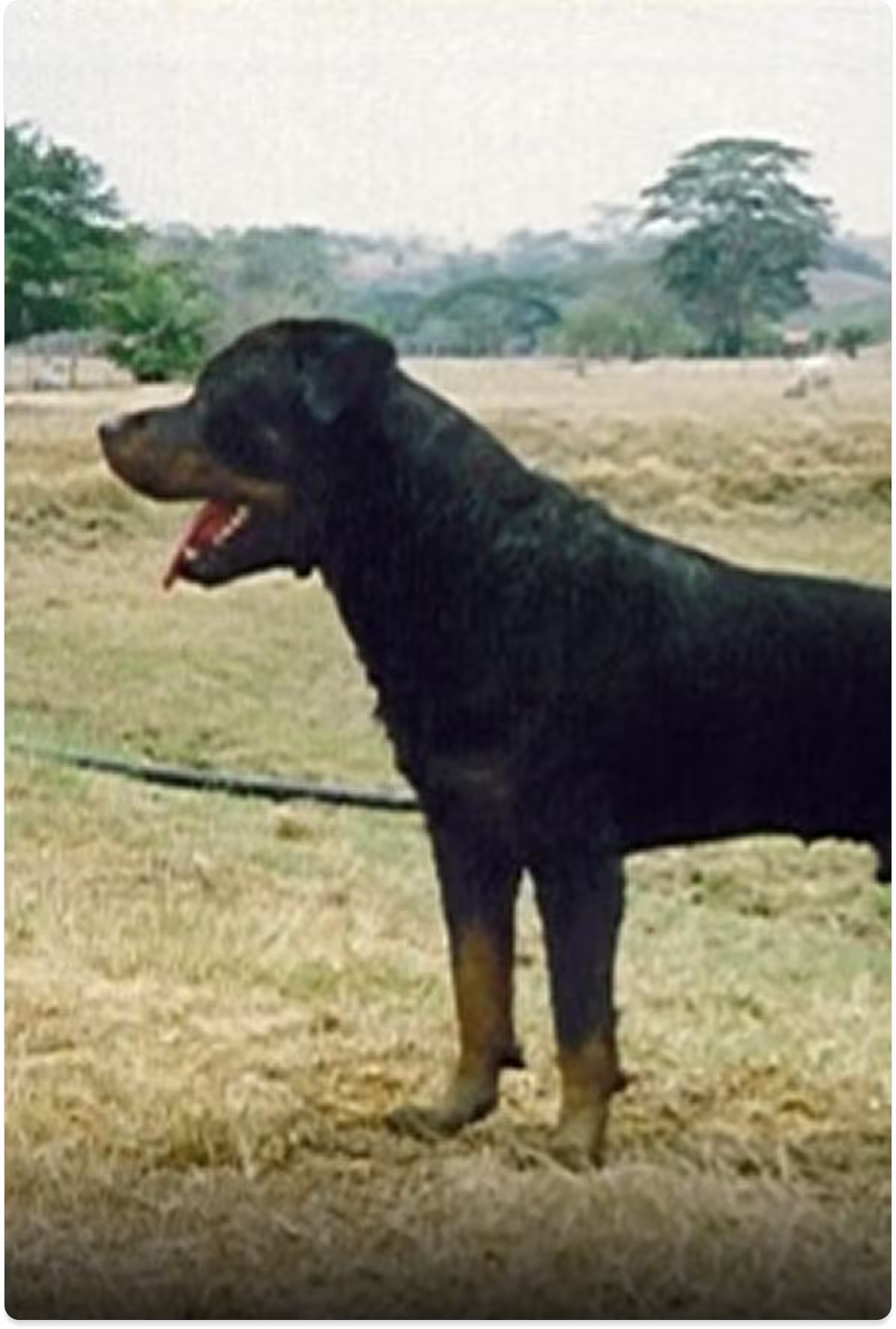
Freud von Jara, Hacienda Bizerta, 1988
In summary, it is unlikely that the first domestic animal is the product of an event forced by man[17]. Before becoming extinct, an ancestral species of wolf gave rise to the gray wolf of our days and to some very sociable individuals who chose to cooperate with man through a fairly prolonged process of self-domestication whose details have been difficult to determine, specifically how, where, and when.
Regarding the latter, there is consensus that the wolf was already a dog at least 15,000 years ago. However, the canine skull excavated in the Goyet caves of Belgium, which lived 36,000 years ago was, according to morphological analysis, a dog, not a wolf, and its genetic study suggests that the dog already differed from the wolf 135,000 years ago.
This fact is not just anything, because it implies that the dog accompanies man from the beginning of humanity. The great difference between those ages is due to the fact that it is not easy to differentiate without ambiguity the first dogs from their immediate ancestors, the wolves, and that, as I already mentioned, there were intermediate species that became extinct[18].
Belgium and the Cradle of the Mechelaar
Regardless of that discussion, which is essentially scientific, it is impossible to ignore the fact that Belgium appears before any other country when talking about the origins of the man-dog relationship. This is not accidental, and that is why the Flemish people have always known about dogs and working with animals in general. That is why they managed to develop several very useful breeds and invented the first sport in history with protection dogs, the Belgian Ring, an idea originated in the mind of Edmond Moucheron in 1880, who also took care of popularizing it in much of Europe before its formalization in 1903 in Mechelse (Malines, in French), the city cradle of the Mechelaar (Malinois, in French).
The Belgians also created in 1899 the first canine school for training police dogs in Ghent, using precisely Belgian Shepherds under the direction of Chief Commissioner Ernest van Wesemael, where police officers from Europe and America came to learn how to do it and import specimens of that breed. Nor is it by chance that Belgium has been the cradle and continues to be the headquarters of the International Cynological Federation (FCI, 1912), which groups the canine societies or Kennel Clubs of 95 countries of the world.
Ulla and Usain van Vessald, Colina K-9, 2025
Functional Groups of the Ancient Dog

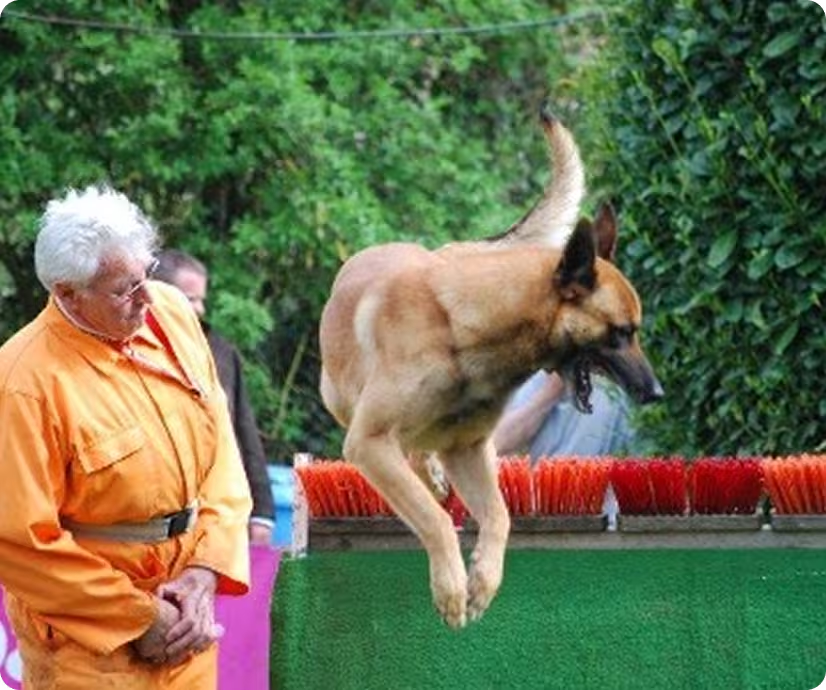
The breeder, master trainer and great friend, Christoph Joris, with Torky dit Edden
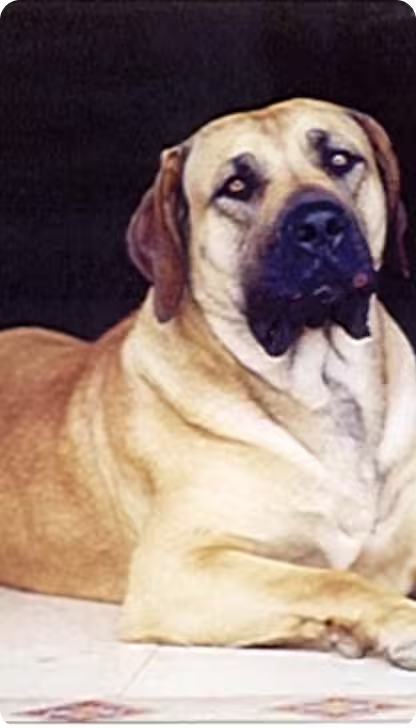
Bellbusk Mama Tau, Alto de Las Palmas, 2000
But the mention of the Belgians connected prehistory with modernity, and this can divert us from what happened in the middle, because canine breeds did not exist 200 years ago.
There were, yes, some groups of individuals without racial identity but very similar functionally, such as the hounds, which helped the hunter-gatherer man to locate, pursue and corner their targets[19]; the catch dogs, which knocked down and killed the animal without the hunters having to expose so much skin[20]; the sled dogs, indispensable for the transport of humans with their loads through Siberia, Greenland, the Arctic, and the Subarctic[21]; the guard dogs, which repelled any invader, biped or quadruped[22]; and the herding dogs, developed after the advent of agriculture and livestock not only to help guide the herds, but to protect them from predators such as the wolf itself[23].
The other version of the story of the dog and man is known as the Direct Route, and was proposed before the Route of Commensalism. The Direct Route argues that man forcibly domesticated puppies stolen from Canis lupus speleaus[11]. Although stealing wolf puppies occurs in the present[12], and must have occurred several times at the beginning of time[13], those attempts were doomed to failure because the wolf, as a species, has always feared man. Those who have done it and have written about the results assure that the probability of domesticating a stolen puppy is very low. This probably explains why the anthropological[14] and genetic[15] data obtained from the most remote canine fossils (from more than 25,000 years ago) point to intermediate subspecies between the dog and Canis lupus spelaeus that disappeared without a trace, suggesting failed domestication attempts[16].
The breeder, master trainer and great friend, Christoph Joris, with Torky dit Edden
The other version of the story of the dog and man is known as the Direct Route, and was proposed before the Route of Commensalism. The Direct Route argues that man forcibly domesticated puppies stolen from Canis lupus speleaus[11]. Although stealing wolf puppies occurs in the present[12], and must have occurred several times at the beginning of time[13], those attempts were doomed to failure because the wolf, as a species, has always feared man. Those who have done it and have written about the results assure that the probability of domesticating a stolen puppy is very low. This probably explains why the anthropological[14] and genetic[15] data obtained from the most remote canine fossils (from more than 25,000 years ago) point to intermediate subspecies between the dog and Canis lupus spelaeus that disappeared without a trace, suggesting failed domestication attempts[16].
The contribution of Canis lupus familiaris to the splendor of the human being is such, that some anthropologists hypothesize that the extinction of Homo neanderthalensis, as opposed to the success of Homo sapiens, was due to the fact that the former always saw canids as food and never imitated the great idea that the latter had when allying with them[24].
Reference
[1]Engel JR. The police dog: history, breeds and service [Internet]. Marengo 2018: published online by the author; reviewed July 2024. Available from: http://www.angelplace.net/dog/.
[2] Vilà C et al. Multiple and ancient origins of the domestic dog. Science 1997; 276:1687-1689. doi: 10.1126/science.276.5319.1687.
[3] Lindblad-Toh K et al. Genome sequence, comparative analysis and haplotype structure of the domestic dog. Nature 2005; 438:803–819. doi: 10.1038/nature04338.
[4] Skoglund P et al. Ancient wolf genome reveals an early divergence of domestic dog ancestors and admixture into high-latitude breeds. Current Biology 2015; 25:1515-1519. doi: 10.1016/j.cub.2015.04.019.
[5] Bergström A et al. Gray wolf genomic history reveals a dual ancestry of dogs. Nature 2022; 607(7918):313-320. doi: 10.1038/s41586-022-04824-9.
[6] Zeder MA. The domestication of animals. Journal of Anthropological Research 2012; 68:161-190. doi: 10.3998/jar.0521004.0068.201.
[7] Larson G, Fuller DQ. The evolution of animal domestication. Annual Review of Ecology, Evolution, and Systematics 2014; 45:115-136. doi: 10.1146/annurev-ecolsys-110512-135813.
[8] Jans N. A wolf called Romeo. Boston 2014: Mariner Books.
[9] vonHoldt BM et al. Structural variants in genes associated with human Williams-Beuren syndrome underlie stereotypical hypersociability in domestic dogs. Sciences Advances 2017; 3:e1700398. doi: 10.1126/sciadv.1700398.
[10] Trut L et al. Animal evolution during domestication: the domesticated fox as a model. Bioessays 2009; 31(3):349–360. doi:10.1002/bies.200800070.
[11] Galton F. Inquiries into human faculty. London 1907: J.M. Dent & Sons.
[12] Smith GK. Slave to a pack of wolves. Chicago 1978: Adams Press.
[13] Mech LD, Jansen LAA. An assessment of current wolf Canis lupus domestication hypotheses based on wolf ecology and behaviour. Mammal Review 2021; 52:304-314. doi: 10.1111/mam.12273.
[14] Germonpré M et al. Fossil dogs and wolves from Palaeolithic sites in Belgium, the Ukraine and Russia: osteometry, ancient DNA and stable isotopes. Journal of Archaeological Science 2009; 36:473-490.
[15]Thalmann O et al. Complete Mitochondrial Genomes of Ancient Canids Suggest a European Origin of Domestic Dogs. Science 2013; 342:871-874. doi: 10.1126/science.1243650.
[16] Freedman AH, Wayne RK. Deciphering the origin of dogs: from fossils to genomes. Annual Review of Animal Biosciences 2017; 5:281-307. doi: 10.1146/annurev-animal-022114-110937.
[17] Shipman P. Our oldest companions: the story of the first dogs. Cambridge 2021: Belknap Press.
[18] Morell V. From wolf to dog. Scientific American Magazine 2015; 313(1):60-67. doi: 10.1038/scientificamerican0715-60.
[19] Hartley O. Hunting Dogs. Colombus 1909: A. R. Harding Publishing Co.
[20] Koungoulos LG, Brumm A. Hunting with dogs: a synthesis of ethnohistorical data and discussion of their implications for prehistoric subsistence in New Guinea. Archaeology in Oceania 2024; 59:1–28. doi: 10.1002/arco.5306.
[21]Sinding M-H S. Arctic-adapted dogs emerged at the Pleistocene–Holocene transition. Science 2020; 368:1495-1499. doi: 10.1126/science.aaz8599.
[22] Cummins B. Our Debt to the Dog: How the Domestic Dog Helped Shape Human Societies. Durham 2013: Carolina Academic Press.
[23] Hancock D. Dogs of the Shepherds: a Review of the Pastoral Breeds. Ramsbury 2014: The Crowood Press.